Q&A with Burnham Banks
Q: There appear to be consensus that most of the tail risk has been resolved and that investors should be overweight risk assets. So the question is, is the world still broken or has it been fixed?
A: Much of the world remains broken, some things have been fixed but most things have just been patched. It’s perhaps useful to classify things that way. What’s still broken? Principal agent relationships which were unresolved remain unresolved. That’s a bit vague and general but it is important nonetheless. The interests of shareholders, customers and employees often conflict and this is an unresolved conflict. I don’t think it’s an easily investable theme but it bears keeping in mind in the greater scheme of things. And it extends beyond business to include governments and their people too.
The transmission of capital between savings and investment is definitely broken. Regulation is squeezing out banks creating the need and opportunity for non bank financial institutions. The free market is slowly reorganizing itself around this theme but I don’t think the macro economic implications have been sufficiently researched and understood. One of the better solutions is a revival or a reboot of the shadow banking system with its structured credit infrastructure, but recent experience will probably complicate developments in that area.
Moral hazard and the role of regulators and government is a question that no one wants to address. Interested parties have gained too much or have too much to gain, or too much to hide, to seek clear, ideological, fundamental bases for defining the role of government. Interference in interest rate markets and unilateral intervention based on expediency don’t fix a problem they only patch a problem. Beyond the moral hazard or fundamental rigor there is the question of long term efficacy. Our solutions to problems seem to spawn further problems down the road.
One area where strong ideology underpins a system is the Euro. Unfortunately, the one place where we find strong ideological basis is where it is fundamentally misguided. The Euro is inefficient; its raison d’être is based in history, politics and culture, mostly superstition. An efficient Euro zone would require considerable domestic price volatility which is something no one, not even the ECB wants to see. The Europeans are wedded to their Euro and will maintain it at all costs. If we have a single currency AND we impose sticky or slowly adjusting factor prices, then imbalances MUST accumulate somewhere.
Q: So what has been fixed? We’ve done so much since the crisis in 2008, surely we can’t not have made any progress.
A: You’re quite right; some things have been or at least are being fixed. The shadow banking system has organized itself at the boundary of regulation to be a more efficient conduit of capital. It is still early days and more capital needs to be diverted away from the banking system but it is a start.
The ECB finally formally accepted the role that was inevitable, to act as lender of last resort. This is required if you insist on keeping the Euro. I am not suggesting that the Euro is a good thing but if you want to keep it, this is how you go about it.
China’s macro prudential management has been quite deft. There is a significant debt pile in China’s shadow banks where the risk management is questionable, but the macro prudential policies to cool areas of overinvestment such as real estate and infrastructure have worked. With inflation under control China has sufficient latitude to address its slowing economy. This could be one of the main themes for 2013, a resurgent Chinese economy. Trade expression may not be as simple as buying
a bunch of Chinese listed equities, however.
The US fiscal cliff is a non event. Just like the budget ceiling was a domestic altercation the fiscal cliff is of more political than economic consequence. If 800 billion of fiscal stimulus failed to lift the real economy I don’t see how 600 billion of fiscal tightening is going to materially damage the economy, especially since the issues have been tabled so early and expectations are so low for a resolution. Sure, it’s not good for the economy but it isn’t catastrophic. So, a non event I think.
Q: With most of the thorniest issues addressed, would you expect risk assets to rally in 2013?
A: Its not a certainty. We barreled into late 2011 with nothing but headwinds and bad news and ended 2012 up with double digit returns in equities and junk bonds. The investor has to consider two things, one is the long list of unresolved or unaddressed problems, and the other is, even if these issues don’t manifest in the current year and fundamentals turn out to be benign, what is the right trade expression.
Q: We see professional investment advisers counseling more equity exposure for 2013, yet equities are vulnerable to higher interest rates, so are corporate bonds all the way from investment to junk, and also by definition, so are government bonds. If so much is dependent on interest rates it implies that future correlations will be high, what then is the right investment strategy?
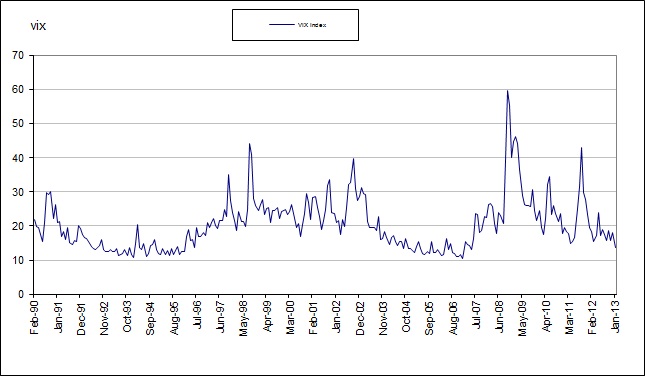
A: Its interesting you noticed the dependence. So much is dependent on rates that one might be tempted to trade rates and nothing else. But there is an asymmetry. Rates can’t fall much more, another 25 basis points and we are at zero. But rates can rise quite a bit. So the short side is easy and cheap to express. CFOs all over are putting on this trade by swapping equity for debt. Bond issuance in 2012 has been remarkably high. The question then on the long side is, how do I profit from continued low interest rates without taking too much risk. The answer is, there aren’t many ways. All of them involve some form of playing the game of chicken, staying on long enough but getting ready to bail. Vols are cheap so one might be tempted to buy puts, but the period of low interest rates can outlast your options. Outright risk on positions with tight stops can allow you to capture more upside than downside for a given move in the market and is my preferred alternative at the moment.
Q: Global debt levels remain elevated, having simply been transferred from private to public balance sheets during the crisis. As debt repayment dampens economic growth, where will earnings growth come from and how should one invest?
A: Sometimes it is useful to think in aggregates but at the security level, idiosyncratic risk can swamp macro issues. Its true that global economic growth has found a much lower long term trend rate, however, within that long term cycle are short term cycles which can be traded. Also, the fortunes of industries and countries and regions can differ greatly. Also, fundamentals and pricing can be disconnected. What it does mean for the investor is that broad based macro views and trade expressions will miss a lot of upside potential while exposing the investor to unintended risks. One has to be specific in buying just the risk one wants while hedging out the risks one doesn’t want. Also, there is no need to be invested all the time. When one is uncertain or has no view, it is perfectly alright to be in cash. Not for too long. The point is that one should only invest if one has a reason and a thesis. This was not the case when we had plain sailing credit infused bull markets but in the current post crisis workout, guerrilla investing is the right strategy.
Q: How do we invest around the risks of Eurozone member defaults? The ECB has promised unlimited asset purchases and the beginnings of a banking union have emerged but it is not clear if Greece, Italy and Spain will be able to find long term solutions without seeking bailouts or defaulting. Markets have taken courage from the short term fixes by the Eurozone but what should one’s longer term investment strategy be?
A: First we should establish the sacred cows. The Euro will be held together. That’s the be all and end al of Euro zone policy. The rest are small details. It would take a default of a country like Italy or France to threaten the Euro. Greece and Portugal are big enough to cause substantial financial damage but not big enough to derail ideology. I would continue a convergence trade between Italy, France and German spreads. Greece will eventually default (it effectively has already) and get restructured (again effectively, it has). A more explicit reorganization may be on the cards so despite the massive rally in Greek debt, I would take my winnings and leave. There are lower spread but higher certainty trades in the larger Club Med.
Q: Inflation or deflation? The scale of banking system balance sheet expansion should suggest that inflation will soon set in and that central banks will struggle to rein in such inflation when it occurs. At the same time the velocity of money has shrunk to sterilize the balance sheet expansion almost completely leading to near deflationary conditions. What is the verdict on inflation and how does one invest in such a climate?
A: Here again is a game of chicken. Two closely related issues plague the bond markets today. First, when central banks print money at the rate they have, they place the economy in a precarious position. The risk of inflation is high, yet this is not the only risk; since central banks’ primary mandate is price stability, there is a simultaneous risk of deflation as central banks are more likely to pull back credit at the first sign of a pick up in prices or the velocity of money. The second is that there is a run on the currency stemming from a crisis of confidence. When central banks print money, they don’t guarantee inflation, they place the economy on the edge, in an unstable equilibrium between inflation and deflation. How does one play this? Floating rate instruments such as leveraged loans provide the positive correlation to higher interest rates with a senior secured position in the capital structure. The risk reward profile of this asset class is quite attractive for this knife edge scenario our central banks have placed us in.
A less crowded view is that irresponsible developed market central banks create inflation in emerging market economies. While market consensus has been that developed market yield curves would steepen and one should overweight emerging market duration, this slightly contrarian view argues for steepeners in emerging markets and flatteners in developed markets, which goes slightly against consensus.
Q: Corporate bonds have done exceedingly well in 2012 and yields have compresses to acutely tight levels. What are the prospects for corporate bonds given the slowing world economy and where are we in the credit cycle? Are ratings downgrades and increased defaults around the corner?
A: Corporate bond yields have indeed compressed significantly over the past couple of years. However, corporate bond yield spreads to US treasuries have not shown the same acute compression. Thus, corporate bonds are not over-valued, compared to US treasuries. If there is a bubble it is not in equities or credit but in the artificially supported US treasury market where yields have been artificially depressed by all the myriad rounds of quantitative easing. Absent QE, the US equity market and corporate bond market cannot stand on its own. The US Fed, however, has the means to maintain QE nearly indefinitely and without bound. This alone supports equity and credit markets in the US, and by extension, elsewhere. The fear is not in fundamentals but in capital flows. So much capital has poured into bonds from investme
nt grade to junk that when capital flows abate, spreads could widen significantly simply because the market has required large volumes of inflows just to maintain spreads and soak up issuance. A reversal of capital flows could catch the market on the wrong foot.
Q: At the end of 2011 investors were expecting a poor year ahead to risk assets. 2012 turned out to be one of the better years for asset returns. At the end of 2012 we hear about China’s economic growth recovering, a rebound in US housing and employment, a more accommodative Japanese government, an end to the risk of the Euro breaking up. It all sounds good. Where might we get it wrong if indeed 2013 turns out to be less positive than we expect?
A: We can see where the problems are, we can see where all the leaks and cracks in the hull are, but what is going to precipitate a retracement, or a bust? That has never been easy to see. To stay uninvested is one response, but for the rich, with luxury inflation running well ahead of CPI, it may be preferable to play the game of chicken, which is to get invested having checked all the exits and unlocked all the doors. There is a cost to being uninvested and you can quantify it as the negative real interest rate. This cost can be likened to an option premium paid to stay out of risk assets. In the past there was a cost to being invested, these days there is a cost to not being invested. It is a cost that has been created by governments and central banks to get private investors, savers, to fund the massive debt piles that they have amassed bailing out the private sector. Unfortunately, by being arbitrary and unilateral, governments’ efforts have led to a potentially unfair reallocation or transfer from savers to borrowers. This we all know and can see. But if I am being asked to pay in order to be uninvested, then I am doubly careful how and if I invest. I’m sorry I cannot be more specific than that. My vision is the average, despite the belief that we are each unique and better than others at whatever it is we do. I am the average and I am Joe Public. I cannot foresee what they cannot foresee. My trading style is to understand Joe Public and pre-empt their behavior by just a bit, just a short space of time. Anything too long and I am trying to be too much smarter than Joe Public, which given that I am Joe Public, is quite risky.
Q: What is your favorite strategy at the moment?
A: Since macro economic trends have been so difficult to understand and policy action introduced a major element of tail risk to traditional macro strategies, one of the better opportunities is in direct lending. Direct lending circumvents banks and Basel 3 legislation, plugs a persistent gap in the transmission of capital and is well compensated for the risk it assumes. There are various expressions of this theme. Real estate mezzanine finance is one. The shortage of bank capital is making solution capital very attractive for lenders. Balance sheet optimization enablers such as sale and leasebacks are also attractive. At the lower risk lower return end of the spectrum there are factoring and trade finance. One controversial area which is quite lucrative is bank regulatory capital relief trades. Here a lender provides subordinated capital for a pool of assets bilaterally agreed with a bank in return for a high, often senior coupon. The bank avoids equity dilution and releases capital at the same time. The risk in these is how they are ultimately regarded by regulators.
Stepping in where old structures have failed is another potentially a good idea. We talked about bank capital and Basel 3 but the ruins of structured credit are also replete with opportunity. While bonds have rebounded sharply and are beginning to look like a bubble, loans remain interesting especially in Europe where CLOs remain moribund. CLOs were the largest buyers of loans and with the 2008 crisis and with current regulation stacked against securitization European loans have not seen the same recovery as in the US while balance sheets remain healthy.
Mortgages are still interesting even after a 3 year rally. Agencies are fully priced given they were the target of the Feds QE3 and the smart money mostly front ran that trade and is now reducing exposure. Non agencies are still good. It’s a pretty idiosyncratic market and you need to be able to pick your points, geographically, demographically, and within the capital structure, and asset types, but non agencies still hold good value. Not as good as before, but better than in other fixed income markets.
I won’t get started on arbitrage, which has become available again, as many investors just don’t trust arb any more. But its there for the intrepid investor. Merger arb, capital structure arb, fixed income arb, its all come back as the markets get more and more unhinged, despite lower vols and higher levels. Its all good.