1

The Origination and Distribution of Intellectual Property and Implications for Growth

‘We think of it, we build it, we buy it.’ This all works nicely until the economy reaches its speed limits and potential. Then the economy overheats and prices rise more quickly. The limits of an economy can be extended by trade and specialization where productive capacity is exported to areas or countries with cheap labour to bring down costs and relieve capacity constraints.


‘We think of it, you build it, we buy it.’ For the last 30 or so years, this has been what the US economy has effectively done. This outsourcing of manufacturing has allowed the US economy to grow with lower inflation and higher productivity than it otherwise would have as the US effectively focused on high value added activities and delegated the lower value added activities. This approach, however, requires some transfer of intellectual property from the idea originating nation to the outsource producing nation. The impact it has on the originating nation’s long term potential growth rate has well mitigated this cost. But there are other costs. The outsourcing of manufacturing means a widening trade deficit, a weaker currency and the need to finance an ever widening current account deficit. The need to keep vendor financing costs low can lead to artificially low interest rates leading to over borrowing and rising asset and real estate prices with unsustainably high debt levels. This came to a head in 2008.  


Since the financial crisis, the US economy has slowed, even in recovery.  And costs are rising in China and the emerging markets where the US outsources its manufacturing. Now, productive capacity is being repatriated as the cost advantages have receded due to lower employment costs at home, lower overall costs of having production closer to home and rising costs of freight and production abroad. This is a return to the ‘We think of it, we build it, we buy it’ model, although some things have changed.


As China has prospered by being the factory of the US, it has come to be a significant source of demand as well. From 2011, consumption as a share of economic growth has grown to 55%. The model that may evolve could be described as ‘We think of it, we build it, we all buy it.’ This could bode well for the world economy. For one, it would reverse the lopsided flow of goods and capital. It would encourage global growth, emerging market consumption and developed world savings and debt reduction. One area would continue to be out of balance. Intellectual property. While China has seen a surge in patent applications the Chinese have yet to demonstrate their abilities in inventing original goods and services and commercializing them. So far China’s efforts appear to be in be in the acquisition of intellectual property rather than in its origination. They do this through blatant copying, formalized IP transfer contracts and corporate acquisition.  

The demographic gains have mostly been reaped in the emerging markets. Capital flows more freely now than ever before. The last factor in long term potential growth is the intellectual property, the technology set, of the economy. China and the other emerging economies have long relied on IP transfer as part of the bargain, granted a grand and complex bargain. but difficult times at home have led to rising productivity and falling costs in developed markets. In order to maintain growth rates, or even to not have them shrink too drastically, China and the other EMs have to increase innovation.

What can they do to introduce balance to the world? Emerging markets need to develop their own intellectual property and IP generating capabilities. It needs to do this by building world class research facilities and attract foreign talent as well as encourage local talent.

Here emerging market countries have an opportunity if not an advantage. Tax.


Most of the developed markets’ governments are either fiscally stressed or distressed. Their herd instinct has been to raise taxes and tax more aggressively. Some countries have taken advantage over this grave myopia or strategic error by welcoming the rich and their capital. This is itself clever but a little myopic. A grander strategic vision would be to provide tax sanctuary to the brains and inventors of tomorrow. If not, then when the pendulum swings and productive capacity returns to developed markets, whether to soak up the unemployed or because automation allows production to be more geographically targeted to final demand, the consequences for the world’s manufacturing centres may be dire.


The Tyranny of Governments. How Politicians are NOT US.

Britain’s MPs have apparently lost the trust of the people. One of the charges leveled against MPs, indeed in any country, is that they are out of touch with society and don’t understand the plight of the people. This is patently false. They understand the people alright; they just don’t want to be the people.

Life is tough for the people. Being an MP has privileges. This is why politicians have lost the trust and admiration of the people. Politicians do not represent the people, they represent themselves. This is of course not just true of politicians, this is true of everyone. Thus it is important to either vote for those most like ourselves in circumstances, and not only that, but ensure that high office means servitude and not dominion. MPs should live our lives, they should be required to take public transport, to live in council housing, to not be exempt from any of the trials and tribulations of the people, they have to get in the queue like everybody else and they have to be paid the median wage. The office of government is sacrifice and service, charity and empathy, selflessness; an honour crowned with thorns.


Yet government has evolved from rule, and not service. This evolution from king to parliament is yet incomplete. And the human species such as it is is unlikely to have the enlightenment or strength of spirit to evolve to a new and selfless ideology. Democracy was an effort to overthrow absolute rule because it was the only way, not because it was a better way. It was more marketable to the people who were necessary for that revolution. That was all. It was more marketable and people bought the idea, full stop. Democracy is a good idea but too easy to mis-sell and the first politicians were quick to see that and capitalize on it. The myth of the properly aligned representative was necessary to mobilize the masses, a bigger force than any army.

In many places this understanding had always been and incumbents have therefore erected insurmountable barriers to entry. Behind every suited, smiling game show host like politician is a little bit of Robert Mugabe, sometimes a big bit.

The British people should see how politician in other countries live and stop complaining.

But change is likely to come as the world becomes more impoverished. You wouldn’t think it from where stock markets were heading. Yet unemployment is high in many parts of the world, wage growth is slow, and food prices are rising, thanks in part to over population and on a shorter term basis to the efforts of central bankers to debase currency. As we find it harder and harder to find more and more work to earn less and less to buy food that costs more and more, apart from a reexamination of our economic systems may come a reexamination of our political systems and the men and women who have come to infest them.


The True Cost of the Euro

With the ECB warrantying that it will be lender of last resort to Euro zone governments it seems that the risk of a break up of the Euro is no longer. Be that as if may, as each day passes the cost of maintaining the Euro becomes more and more apparent. The charge is not one of market turmoil, sovereign funding cost, financial sector imbalances or fiscal discipline but a more fundamental issue of price discovery and factor and goods market equilibrium. If a single currency is to persist, domestic prices of all things, goods, services and inputs, need to be flexible so that markets clear. Yet we know that for various reasons wages tend to be sticky upwards, that is, wages are easier to raise than to lower. Labour laws and unions are the main reasons for this asymmetry of wage friction. As a result, the labour market fails to clear and we have Euro zone unemployment close to 12% with youth unemployment substantially higher and Club Med countries running at double the zone’s average.

Taken together the common currency and current labour market regulations fail to clear the labour market.


More generally, a common currency requires factor price flexibility to achieve market clearing efficiency. The price of capital and land are less problematic. Land prices in Spain and Italy have been correcting since 2008.


This may impoverish home owners and impair consumption through a negative wealth effect but they are less debilitating and political. And the downward adjustment is economically a good thing. If governments then try to prop up housing values or interfere in markets for capital then the inefficiencies that plague the labour market will be replicated in these other factor markets. Capital markets already face inefficiencies arising from Basel rules and the Eurozone’s own efforts at financial sector regulation that they need not be exacerbated in the Euro zone. Land is already facing its own analog of unemployment. This is the true cost of maintaining the Euro.


Now we are told of all the trade barriers that would automatically materialize should the Euro be dismantled. This need not be. It is, only because we make it so. Any new impediments would be political constructs which had been enacted and not some natural behavioral phenomenon.


Today, it seems the Euro is safe from fission, saved by the ECBs backstop. How long will it be before Euro zone leaders, economists and people realize the true cost of maintaining the Euro? It may not be an instantaneous, financial market crisis type event that breaks the Euro, just too many people unemployed for too long.


Risk and Damage. Worry 2013

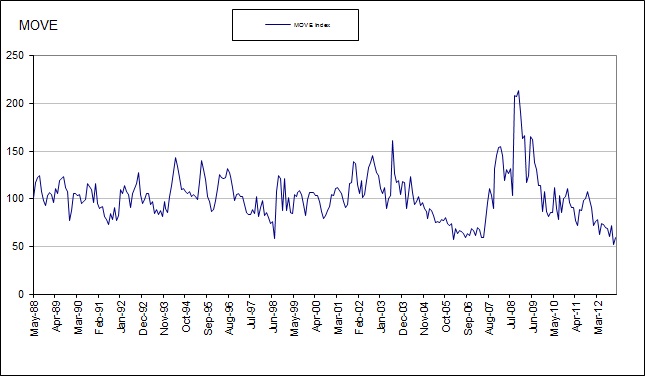
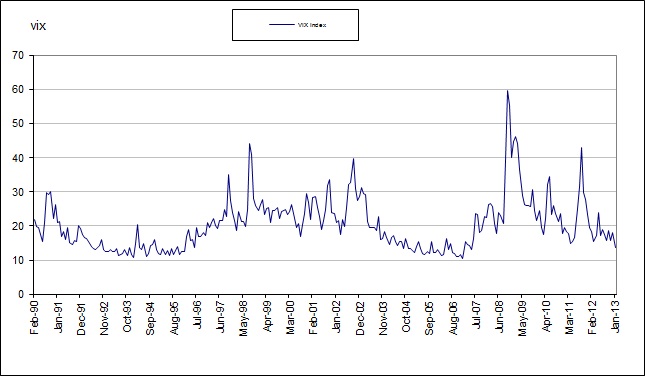
The VIX index has sunk to remarkably low levels, as has the MOVE index. Yields on bonds from treasuries to investment grade to junk have compressed significantly. The market is now more optimistic about the prospects for a recovery in China, a more robust US housing market and the ability of the Europeans to hold their common currency together. All is well.

Time to worry. Risk is highest in calm waters. Once the iceberg hits, its just damage. The best asset can be priced sufficiently highly to be a poor investment, and the worst asset can be priced sufficiently lowly to be a good investment.

MOVE Index

VIX Index