1

Global Trade War. Part II

The Trade War continues. Since 2011, the Obama administration has been actively pursuing a program of reshoring.

http://agmetalminer.com/2015/01/22/obamas-manufacturing-centric-state-of-the-union-youll-never-hear/

Donald Trump’s agenda only seeks to bolster or exacerbate an existing trend. As global growth slows, every country seeks to become more self-sufficient and insular. Trading nations and those with a small or ageing population do not have the back stop of domestic consumption, and will suffer. Populous regions will seek to tap domestic consumption and investment as sources of growth. The strategic responses of the various regions are already becoming clear. China is a prime example with a stated objective of being more reliant on domestic consumption and less dependent on exports.

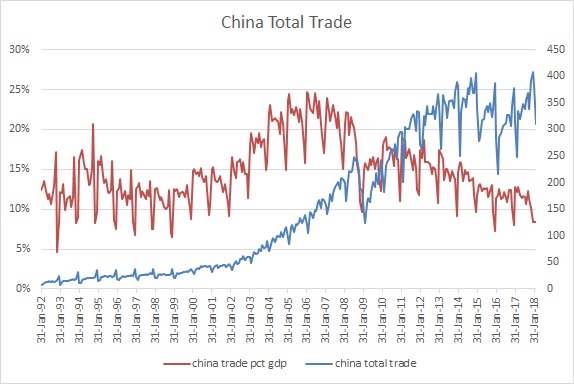
In China, total trade, here taken to be imports plus exports, have stalled and as a percentage of nominal GDP (ignoring inflation base effects), peaked in 2007 and has since been declining.
 

The decline in trade has also brought with it a decline in manufacturing, as factories facing a foreign export audience are wound down and new ones facing a domestic audience are established. Such a decline has had a transitive impact on industrial commodities.

2016 was a year of recovery in manufacturing, a recovery that has extended well into 2017. This is likely a rebound due to the differential times in decommissioning old, export facing assets, and building new, domestic facing ones. The rebound has reversed the decline in manufacturing and commodities. A growth rebound also impacts demand for imports and reverses the decline in global trade. However, this is reactionary rather than causal. As the world’s productive assets settle into a new equilibrium, trade will stabilize at a lower level. If countries like the US under Trump accelerate protectionist policies, trade could resume its decline. In any case, lower trade is inflationary, ceteris paribus.

The fact that inflation is weak is all the more concerning in the context of reduced trade. It suggests that median output and income is weaker than mean (average) metrics. This could likely be due to a skew in the population for output and income data. In fact it supports the anecdotal evidence that wealth and to a lesser extent income inequality is acute in the developed nations.

The Trade War hypothesis is part of a more general and pervasive adversarial world. We see examples of this in the failure of the Accord de Paris, Brexit and the perceived Siege of Britain, protectionism in the US, Chinese policy to maximize FDI and minimize ODI (which is the investment analogue to trade war), China’s belligerence in the South China Sea, to name but a few.

In such environments, self-sufficiency is a sound strategy, provided one has the resources. Countries lacking in land, resources, labour and knowledge, will have the most difficult run of it.


10 Seconds Into The Future. Peripheral vs German Yields. ECB.

The spread between Spanish and German bonds has widened from 0.93 to 1.22 in 6 weeks. While the spread between Italian, Spanish, Portuguese and even French bonds and German bunds has widened in the last 6 weeks, Spain’s reaction is the most substantial. A referendum on October 1 for Catalan secession is raising political risk in Spain.

Eurozone bonds have been diverging for over a month, in part due to expectations that the ECB will have to stop its bond purchases. While Eurozone economic growth is perking up it is driven mostly by Germany, the country least requiring monetary accommodation. The ECB’s intentions to taper QE are driven not just by divergent economic growth but by technical constraints based on its capital key which forces it to buy more German bonds than peripheral ones. It will have to deviate from the capital key or find a replacement for the current QE, which will have to stop. The most intuitively probable replacement is its unconditional LTRO which will encourage local banks to resume buying of government bonds which they can finance at zero. This will force convergence as 5 year French and German bonds are the only ones trading below zero yield.


Global Trade War. Episode II

The Trade War continues. Since 2011, the Obama administration has been actively pursuing a program of reshoring.

http://agmetalminer.com/2015/01/22/obamas-manufacturing-centric-state-of-the-union-youll-never-hear/

Donald Trump’s agenda only seeks to bolster or exacerbate an existing trend. As global growth slows, every country seeks to become more self-sufficient and insular. Trading nations and those with a small or ageing population do not have the back stop of domestic consumption, and will suffer. Populous regions will seek to tap domestic consumption and investment as sources of growth. The strategic responses of the various regions are already becoming clear. China is a prime example with a stated objective of being more reliant on domestic consumption and less dependent on exports.

In China, total trade, here taken to be imports plus exports, have stalled and as a percentage of nominal GDP (ignoring inflation base effects), peaked in 2007 and has since been declining.


(data source Bloomberg)

The decline in trade has also brought with it a decline in manufacturing, as factories facing a foreign export audience are wound down and new ones facing a domestic audience are established. Such a decline has had a transitive impact on industrial commodities.

2016 was a year of recovery in manufacturing, a recovery that has extended well into 2017. This is likely a rebound due to the differential times in decommissioning old, export facing assets, and building new, domestic facing ones. The rebound has reversed the decline in manufacturing and commodities. A growth rebound also impacts demand for imports and reverses the decline in global trade. However, this is reactionary rather than causal. As the world’s productive assets settle into a new equilibrium, trade will stabilize at a lower level. If countries like the US under Trump accelerate protectionist policies, trade could resume its decline. In any case, lower trade is inflationary, ceteris paribus.

The fact that inflation is weak is all the more concerning in the context of reduced trade. It suggests that median output and income is weaker than mean (average) metrics. This could likely be due to a skew in the population for output and income data. In fact it supports the anecdotal evidence that wealth and to a lesser extent income inequality is acute in the developed nations.

The Trade War hypothesis is part of a more general and pervasive adversarial world. We see examples of this in the failure of the Accord de Paris, Brexit and the perceived Siege of Britain, protectionism in the US, Chinese policy to maximize FDI and minimize ODI (which is the investment analogue to trade war), China’s belligerence in the South China Sea, to name but a few.

In such environments, self-sufficiency is a sound strategy, provided one has the resources. Countries lacking in land, resources, labour and knowledge, will have the most difficult run of it.


Central Banks and The Things They Get Up To

Analgesics are addictive. The US Federal Reserve has cut rates to address every downturn but sows the seeds of subsequent downturns so it can never quite normalize rates before the next crisis occurs.

Analgesics are very addictive. Before 2008, the Fed used interest rates to manage the speed of the economy. It has now discovered the wonders of QE. Expect bond buying to be deployed the next time there is a crisis.

Cutting rates and QE haven’t had the desired effect on real output and inflation. Asset markets, however, have done well. The result is that asset owners, especially leveraged ones, have done well while workers and people whose source of wealth and income is employment as opposed to dividends and coupons, have done poorly.

Interest rates and inflation. It is not clear that cutting rates incites inflation. Low interest rates can make capital cheaper encouraging over-investment and over-capacity leading to disinflationary pressure.

Interest rates and inflation. Low interest rates also makes it cheaper to finance the buying of factors of production relative to renting these factors. Labour is rented, fixed capital is bought. Low interest rates can therefore lead to underemployment of labour and overemployment of capital.

In a knowledge economy, labour’s share of income should fall over time. Entities and companies can accumulate intellectual property without bound. A single individual, however, intelligent, can accumulate only a lifetime’s intellectual property and has their intellectual capital bounded.

Unequal distribution of wealth and income complicates policy. Monetary policy faces a range of velocities of money corresponding to richer households which have a lower marginal propensity to consume (and a higher savings rate), and poorer households with a higher marginal propensity to consumer. In a highly unequal economy where the distribution is skewed, that is there are a very small number of ultra-rich, and a substantial majority of less rich, the velocity of money is lower than expected and monetary policy is blunted.

Interest rate policy impact depends on the prevailing level of interest rates. Raising rates when rates are low is not the same as raising them when they are high. When rates are low, interest rate hikes raise debt service costs significantly more than when rates are high. This can complicate central bank policy as they begin to retreat from accommodative policy.

As a reminder of the sometimes ignominious history of central banking. the world’s first central bank, Riksbank, was a failed commercial bank whose founder Johan Palmstruch was condemned to death for the collapse of the bank. The world’s second oldest central bank, the Bank of England, was created to monetize 1.2 million pounds of the British national debt which was raised to rebuild the navy.


ECB meeting 7 September 2017, what to expect:

In late June at the ECB Forum in Sintra, the ECB Chairman Mario Draghi remarked that “all the signs now point to a strengthening and broadening recovery in the euro area.” The market took this as a sign of the impending end to QE and the EUR began a rally from 112 to 119 and change. The ECB was quick to moderate the message soon after Draghi’s remarks. More recently the ECB has expressed concerns about the strength of the EUR, and at Jackson Hole this week, Draghi was careful not to telegraph any intentions as to the future trajectory of QE or interest rates.

On Sep 7 next week, the ECB will meet to decide on monetary policy. It is clear that the Eurozone economy has stabilized and is in the middle of a cyclical upturn, led mostly by Germany. However, growth rates are not equal, nor are labour markets. The variation of unemployment in the Eurozone ranges from 3.8% in Germany to 21.7% in Greece with Italy at 11.1% and the Euro area average at 9.5%. Greece and Ireland have negative rates of inflation with the region average at 1.4% while economic powerhouse Germany manages only 1.67%.

Given the ECB’s mandate of 2% target inflation, it is clear that policy has not achieved its aims. Not only that, it exposes the fact that policy is unable to address the varying growth, unemployment and inflation rates of the member countries. The single currency may have brought about convergence in interest rates up until 2008 but it has if anything exacerbated divergences in factor prices in the Eurozone, as conventional economics predicts it should if member countries have different factor productivity, which they do.

Not only has policy not achieved its aims but the current QE will run into technical difficulties. By buying bonds pro rata to the capital key, the ECB’s accommodation is strongest in Germany and weakest in the periphery. The limitations on how much of each issue the ECB (and by extension the national central banks) can buy and the issuance of bunds means that the ECB will not be able to maintain its volume of bund purchases much longer. Since it has to buy according to the capital key, this limits how much it can buy of peripheral bonds. The ECB may have to taper its asset purchases simply because it runs out of bunds to buy.

What the ECB needs to do is to find a way of buying or enabling the buying of, Eurozone bonds according to the needs of each economy, and not according to the capital key. Given how the rules are drawn up, and the opposition it faces from the Bundesbank, it will not be able to directly buy bonds. It will likely have to resort to a mechanism it first engaged in late 2011, the unconditional LTRO.

Why the original LTRO worked:

The national private commercial banks bought bonds which the ECB could not. As long as the bonds they bought were eligible collateral, and had a yield above zero, private commercial banks would have an incentive to buy them, since they could be financed effectively at 0% in the LTRO.

The original LTROs were not conditional on the size of banks’ loan books. Banks could buy as much of sovereign bonds as they liked with LTRO money. Under the later TLTROs, the size of their LTRO utilization was conditional on their loan books. If the banks could not or would not increase their loan books, they could not increase their LTRO participation. This is one reason why TLTRO take up (some 400 billion EUR) was much smaller than LTRO take up (which topped a trillion EUR).

The LTRO is ideal in encouraging private commercial banks to perform proxy-QE for the ECB, and would circumvent the capital key. Assuming that the single currency did not break up, banks would be incentivised to buy bonds of Italy, Spain and Portugal, where yields were highest, and not bonds of France and Germany where yields were tightest, and up to 10 year, negative. Assuming that there was some default risk and break up risk, at least the national private commercial banks of Italy, Spain and Portugal would buy their own respective national debt. If nothing else this would push also their current accounts further into surplus and narrow the spreads to French and German bonds.

If we believe that the ECB intends this route, then we also know that they are unlikely to raise interest rates since the LTROs require super cheap funding to work.

The September 7 ECB meeting is very much up in the air. The last 3 months have seen conflicting signals and some clumsy communications by the ECB. I believe that in the current environment, the ECB will do the following:

1. Hold interest rates at -0.4%.

2. Announce a tapering of bond purchases in the public and private markets.

3. Announce a resumption of unconditional LTRO up to a size of 1 trillion EUR over the next 12 months.

The consequences of this, based on lessons and parallels drawn from Dec 2011, could be:

1. Exert downward pressure on the EUR.

2. Bring convergence between peripheral rates and bunds.

3. Trigger a rally in EUR high yield.

4. Impact on equities not so certain.