1

Why inflation is low and central banks are confused and what can be done about it.

For central banks the world over, inflation is too low, apparently. Continued efforts to reflate economies have led to some growth and employment but have not had much impact on inflation. As asset markets make new highs and valuations get more stretched, labour markets become tighter and growth stabilizes, central banks are at a loss as to why their policies have not created more inflation. Despite highly accommodative policies we continue to see weak consumer price inflation and weak wage growth.

One distinction that perhaps blunts measurement is that there are various strata of society and each has their own consumption patterns and thus price baskets. From 1982 – 2016, the Forbes Cost of Living Extremely Well Index (CLEWI), has risen at 5% per annum compared with the CPI which rose at 3% per annum. A 2% gap over 35 years adds up. Manhattan luxury housing has risen at a pace of over 6% p.a. over the last 10 years compared with 0% for the Case Shiller 20 City Composite Index. Coutts Luxury Price Index rose 6% YOY compared with a UK CPI of 2% and in China, the Hurun Luxury Price Index rose at 3.6% July YOY compared with a CPI of 1.4%.

Aggregate CPI numbers are blunted by acute inequality. The CPI basket is weighted towards goods which for the rich are at saturation and for the poor are facing low demand. The economy relevant to the rich is vibrant, healthy and inflationary. For the poor, stagnant wages and a shrinking share output and income cap demand.

Central bank efforts have not targeted the right areas, which are employment and real output. By focusing on asset solutions and funding costs, regulators have enriched those with outsized access to credit and high exposure to investments in assets. By suppressing the USD yield curve, the Fed supports higher valuations for equities and credit which are generally owned by higher income and more wealthy people. This section of society, being wealthier, save a greater proportion of incremental wealth so that the wealth creation fails to trickle down and the velocity of money falls, limiting the transmission towards higher inflation.

Low interest rates also alter the labour to capital mix by distorting prices. Low interest rates and easy access to credit encourages investment in fixed capital relative to labour. A firm can borrow to fund wages but it the cheaper credit becomes the cheaper it is to invest in fixed capital that can be depreciated aggressively increasing the returns on investment in future time periods. Put simply, a firm can own fixed capital but it can only rent labour. When rates are low, it makes sense to own your factors of production rather than rent them. Low rates skew the labour capital mix and suppress wages.

Another effect is that as QE was undertaken, inflation expectations were raised. Conventional economics indicates that rate cuts and monetary expansion lead to higher inflation. This did not happen. Instead inflation was low and assets rose. The inflation to money supply relationship is not precise and since there is a vector of goods and prices, it is not clear in which goods markets the inflation will take place in. If there is excess capacity in a particular market, even if demand manifests there, output may rise to compensate for any inflationary pressure and prices might even fall, theoretically. To complicate matters, for all practical intents and purposes, this vector of markets into which money could flow includes not only goods and services but assets as well. If inflation expectations were being driven up the response could have been to consume in the current period or to buy claims on future production, in other words, equities or high yielding credit.


Policy needs to look not only at aggregates but also at the structure of an economy. A country has to decide if its policy is there to serve the many or the few, the rich or the poor. And while the right answer is obvious so is the outcome. Even assuming away cynical behaviour, any policy that favours the poor against the rich, in relative or absolute terms, will likely encourage tax or regulatory arbitrage. An internationally coordinated solution is needed to ensure that if tax advantages are sought then they are the result of true immigration. This is difficult but adoption of Common Reporting Standards, for example, are a step in the right direction.

An internationally coordinated tax system would either require convergence of tax rates, or will encourage physical or true immigration, sometimes to the detriment of the source country. Tax convergence is unreasonable given the needs of individual countries. A tiered global, national, state tax system might be a solution but the coordination it would require to design let alone implement is still far away.

Tax funded transfers are only one way of addressing inequality, not just of wealth but of impact on the economy. A better understanding of how interest rates impact the economy at the micro level will also make for better central bank policy. Current efficacy of policy has been questioned not just by the public but by central banks themselves. To carry on a policy when its impact is not well understood is inadvisable.

The distortionary impact of interest rate policy on business planning could advise a tax code that applied a policy-externality-weighted expense system to calculate tax credits to compensate. To encourage a reduction in youth unemployment, a company hiring under 25’s could deduct more than 100% of their wage costs when calculating their taxable income, for example. Such a system of weighted expense tax deductibility could be used to fine tune behaviour to achieve policy goals.

Compensatory training and skills upgrading could be provided and tax-funded to lower wealth and income people to reduce the skills gap and narrow the potential wealth trajectory.

Real estate taxes can also narrow the wealth gap as real estate is a significant store of wealth. Real estate should be a resource or used for dwelling and not investment. Supernormal profits should be taxed and used to fund the less wealthy.

The purpose of these apparently socialist and redistributive policies is not to pursue a social agenda but to address a fundamental inadequacy of policy. Its aims are to increase development, growth and employment for the majority of the population and not an aggregate that is highly skewed because of acute inequality. It is hoped that by rethinking and redesigning policy, the interests of the many are served over the interests of the few.


Dumb Forecast For S&P500 Returns

Let us say that you have made 16% per annum for the past 2 years investing in the S&P500. As at this point, you have.

What is the return you would have to make over the next 2 years so that your 4 year average return was equal to the long term potential return of the S&P500?

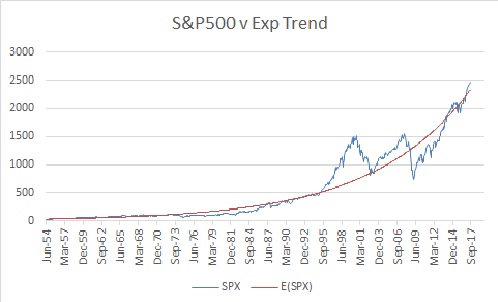
The 63 year historical average return of the S&P500 is about 10%. I used data from 1954 to the present because that’s all I could get. Sorry. If you compounded at 16% for the past 2 years, you would have to make 4.3% p.a. for the next 2 years to bring you back to this average.

What if you thought that long term returns were 7% going forward? Then your next 2 years’ average returns would have to be -1.30% p.a.


Chart of S&P 500 and its Exponential Trend Line:


US Debt Ceiling 2017. Mexican Stand-off Between Republicans Everywhere.

The best thing investors can do about the US debt ceiling issue is to talk about it and do nothing. In 2011, a Democrat White House and a Republican Congress had a similar debate about the debt ceiling. The Obama administration argued that failure to raise the debt ceiling would result in a sovereign default which would lead to an international financial crisis. On July 31, 2011, President Obama announced a bipartisan agreement on deficit reduction and some flexibility around the debt ceiling.

Stock markets stalled after a yearlong rally but US treasuries which were at risk of a downgrade rallied through the 1st half of 2011 while fraught negotiations were ongoing. It is difficult to attribute factors for the volatility in equities and credit given that Europe was undergoing its own sovereign debt issues.

On Aug 3, a day after the debt ceiling deadline, the national debt surged almost a quarter of a trillion USD, to over 100% of GDP for the first time since WWII, and a few days later, S&P downgraded the US from AAA to AA+. US treasuries rallied with 10 year yields falling from 2.5% to 1.75%, and stock markets across the world sold off and credit spreads widened. It all made perfect sense. The sovereign issuer had been downgraded, the national debt had ballooned, and demand for US treasuries rose. Meanwhile, demand for private assets, fell.

Yesterday, 23 Aug 2017, Donald Trump brought up again the subject of the debt ceiling and the potential shuttering of the US government. Congress needs to approve a budget as well as raise the debt ceiling by 30 Sep. Trump has signalled that he wants his Mexican Wall to be included in the budget, that same wall that the Mexican’s were supposed to pay for. And if he doesn’t get what he wants, Trump has threatened to veto the bill. “One way or another, we are going to get that wall”, vowed Trump. Yet earlier this year, Trump was still insisting that Mexico pay for their own wall, if indirectly through import tariffs, a somewhat self-defeating strategy. Now it appears that Trump is looking for alternative finance for the wall, and that is the US taxpayer, less indirectly. Perhaps some of the investment bankers on his residual team could come up with creative conduits so that the American money paid to Mexico could be channelled somehow into the budget to fund the wall. If tariffs can raise sufficient revenue and be earmarked especially for the wall, it might all work.

In the meantime, Paul Ryan has said that Congress would rather not shutdown the government. And with Trump’s receding approval ratings, and Senate and House elections in just a little over a year (Nov 2018), the Republicans will be careful not to come across as obstructive, especially since they control the House, Senate, and to the extent that anyone has any control, the White House.

6 years ago Democrats and Republicans came together to craft a deal, imperfect, but a deal. It resulted in a sovereign downgrade and some market volatility, although ironically, the downgraded instrument rallied hard. We therefore have somewhat of a guide as to what could happen if there was a Mexican stand-off; between Republicans in the White House, Republicans in the House and Republicans in the Senate.

How concerned should investors be about the current situation? Probably not very. The debt ceiling is academic. The budget determines the debt issuance, not the ceiling. A default by the US government would have sufficiently serious consequences that it would not be allowed to happen, especially since it is a technicality. Imagine if the most widely used collateral in secured lending markets defaulted. The implications would go well beyond American borders. Technical solutions would be found to avert a default, some of which were tabled in 2011 which would not require endorsement of the executive.

US treasuries would probably rise, as they did in 2011 before and after the deadline. This may seem irrational but the value of a security is what everyone agrees it is. There is little intrinsic value to all the paper claims that comprise the liquid markets.

The equity and credit markets might fall given lofty valuations, but mitigating this could be that this is not a new experience. The S&P500 fell 18% during the 2011 standoff, but this was the confluence of the novelty of the debt ceiling negotiations as well as economic troubles in Europe. Lower bond yields would relieve some of the relative over-valuation of equities which might provide some support. They would have the effect of a de facto rate cut. In the extreme case, the Fed may even cut rates or belay balance sheet normalization, resuming liquidity operations to support asset markets.

On the downside, the S&P trades at 21X today versus 16X in 2011, suggesting a 24% downside if multiples revert to those levels, more if they overshoot. This calculation should be discounted as equity markets are hardly scientific or rational in the short term, and the analysis is somewhat crude anyway. If confidence prevails, equities might dip and resume their climb. If confidence fails, even if the Republicans tame their President and find an amicable budget solution, equities could fall more than 24%.

In 2011, a Democrat in the White House faced off against a Republican Congress, but one had the sense that both sides would be strenuously resolute, but responsible and rational. Today we have Republicans in each pillar of government but an erratic President who has no qualms about alienating his partners in the House and Senate. So far, faced with stern resistance from his Congress Trump has always backed down or been thwarted but there may be limits to how much disappointment and ignominy he can endure.


It is always a difficult time to invest. Are equities and bonds overvalued?

It is always a difficult time to invest. When markets are turbulent and falling, investors will tell you it’s a difficult time to invest. When markets have been rising on low volatility for as long as the current market has, investors will tell you it’s a difficult time to invest.

Why is it such a difficult time to invest when volatility is low and markets continue to rise gently? Surely these are ideal conditions for investing? Central banks have underwritten the markets for 8 years now, and even as they lessen their accommodative efforts, they do so to enable further accommodation down the road should the economy weaken. The fact that they consider conditions sufficiently robust to lift their foot of the accelerator is surely reassuring news. They are far from slamming on the brakes. The financial system which had become acutely stressed in 2007 has been repaired and is ready to resume normal service. Growth has recovered almost universally, and even international trade has rebounded and with it global manufacturing. Economic conditions look healthy. Even the chronically lethargic Eurozone has caught up and is currently outrunning the US.

Investors are worried about valuations and they are right to be concerned. Equity valuations are as high, higher in some cases, than they were in 2007 just before the crisis. The S&P500 for example trades on 21X earnings whereas it traded at around 18X pre crisis. Eurozone equities are also trading above pre crisis valuations as is India. However, equities are not universally more expensive. Nasdaq is actually cheaper today than it was 10 years ago. Chinese equities, whether listed in Shanghai or Hong Kong are also cheaper today than 10 years ago. The dominance of US companies and markets skews valuations so that taken in aggregate, equity markets are expensive.

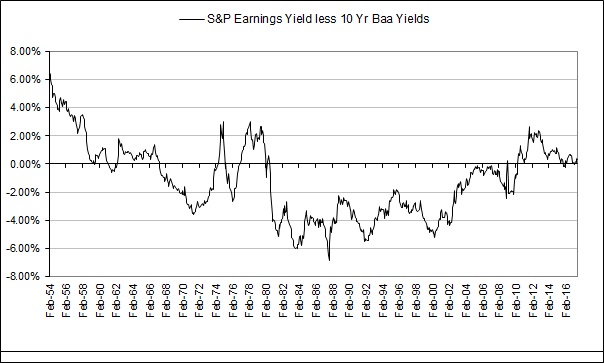
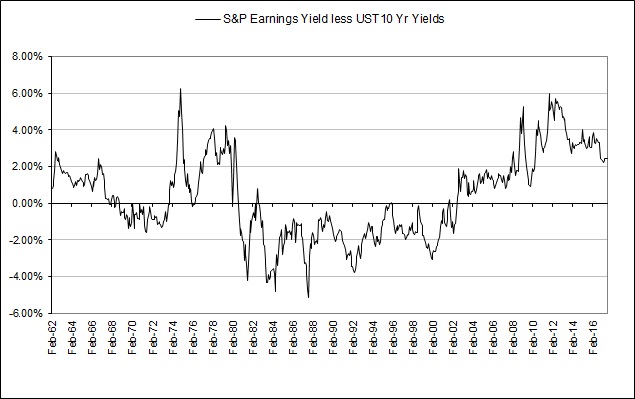
When equity valuations are seen in the context of alternatives or opportunity costs, the picture is more nuanced. The equity earnings yield premium over 10 year US treasuries finds that equities were extremely cheap in 2011 and have become more expensive since then, but remain probably in the region of fair value to slightly cheap, certainly cheaper than they were in the years 2003-2007.

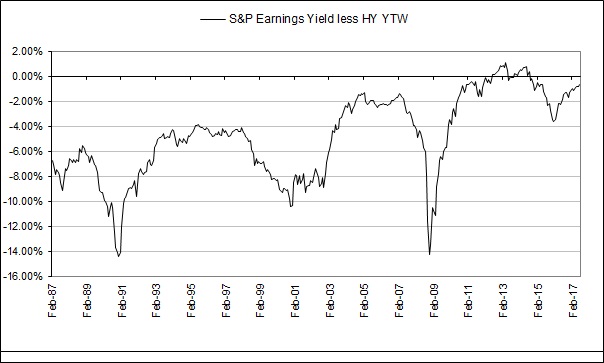
Comparing equity valuations relative to investment grade credit also finds that equities are not overvalued. In fact they may be an indication that corporate investment grade is overvalued. The same is seen when compared with corporate high yield.


Are equities expensive? 


Are equities more expensive or corporate investment grade bonds?  (High is cheap, low is expensive)

Which is more expensive, equities or corporate high yield? 


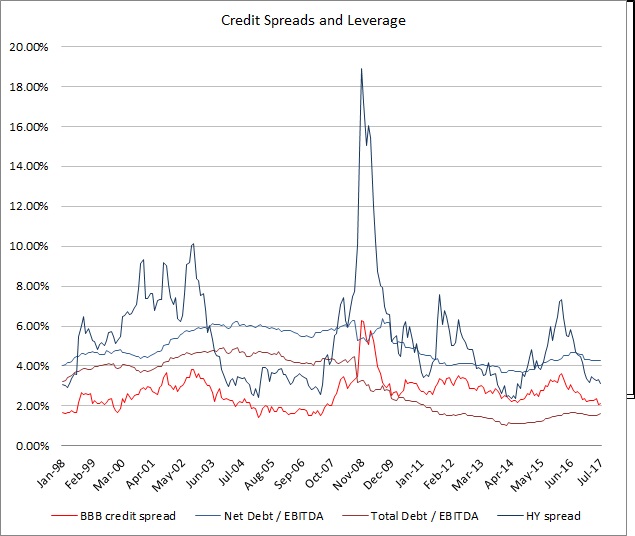
Which brings us to the complaint that bond markets yield little value. Economic conditions are healthy and corporate balance sheets have reasonable leverage. Barring some areas where leverage has surged, notably China, leverage is closely monitored and as a result companies are less likely to lever up irresponsibly. China, by the way is a bit of a special case as the leverage has increased most where the lenders are state owned and the borrowers are state owned; one might call it off-balance-sheet QE. And even here, the PBOC is trying to ‘normalize’ its policy. In the US, the Fed is clearly of the view that corporate America is able to operate under normal conditions as opposed to the ‘intensive care’ of the past 8 to 9 years.

Investors’ concerns lie not so much with fundamentals but with pricing. HY spreads are at their tightest since the crisis and IG spreads are not far off their lows (achieved in 2014). When it comes to floating rate paper, the spreads are even tighter. Fears of rate hikes by the Fed have driven investor demand for leverage loans resulting in desperate buying.


US credit spreads are tight. But leverage is receding. 


Now there are ways to eke out a higher return, sometimes even at lower risk, and one can invest in hedge funds which take advantage of mis-pricings through arbitrage or relative value but alternative investments have alternative risks.

In fixed income, one can venture into the ABS market. Non-agency RMBS has done well and the nascent agency credit risk transfer market is another attractive area. Structured credit is another area where value can still be found. Subordinated bonds and preference shares are another potential area to hunt for returns. But with each basis point of additional yield comes additional types of risk. It is not that one should embrace the risks or dismiss them but that nothing is for free and the investor must satisfy their own understanding of the risks.

In the area of hedge funds, years of central bank policy has raised correlations and dampened volatility, a one-two knock out to traders seeking to buy cheap assets and short expensive ones. Even cross capital structure arbitrage yields acutely low unlevered returns forcing hedge funds to either leverage up (assuming their prime brokers or investors will let them), or print a lower return. Central bank policy has also confounded traditional transmission mechanisms between policy, the economy, and asset markets delivering global macro funds a particularly difficult environment.

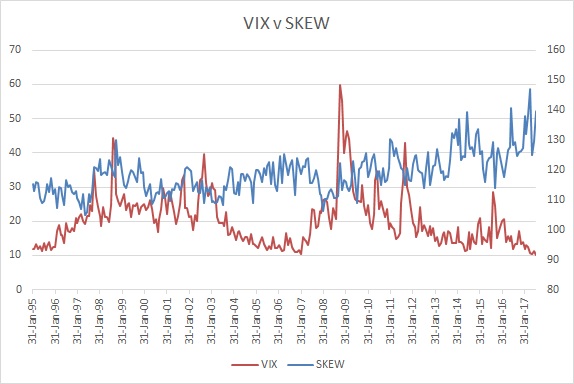
As for systemic risk and investor complacency, we recall an old chart showing both VIX and SKEW. VIX is a widely accepted indicator of investor confidence or complacency. Of late, VIX has fallen to historically low levels and seemed impervious to events of economic and political significance. SKEW, however, shows that post 2008, investors have in fact been sceptical if not cautious. VIX has been depressed by volume call writing and SKEW has been lifted by volume put buying. The divergence between SKEW and VIX are hardly a sign of complacency. Rather it is indicative of the vigilance and worry of at least a segment of investors that has pervaded markets since the crisis as investors brace for the next bust.


Complacency or vigilance? Optimistic investors will not over-supply calls or over-demand puts. 


The only thing once can be pretty certain of in investing is that your wealth will not be the same as when you started. With some diligence and intelligence it should grow at a reasonable pace not far from the rate of growth of the economy or corporate profits. In the short run, volatility will dominate trend and in the long run the reverse is true. It is important for an investor to define their own style of investment and to maintain a consistent strategy lest one is repeatedly whipsawed by the market. Traffic in lower quality assets and one has to be nimble. Invest in higher quality assets and one has to be patient. It is extremely difficult to monetize both noise and signal. To make things a little easier.


*All chart data sourced from Bloomberg


Singapore Property Has Bottomed. Will Rise. Beware The Rebound.

The Singapore property market has been receding slowly since 2013. It has bottomed and will rise. There are a number of factors behind this.

The Singapore economy is stabilizing and will accelerate from this year onwards. No economy slides for multiple years without recovery. The Singapore economy is an uncommonly trade oriented economy with imports and exports together accounting for over 400% of GDP. International trade weakened from 2011 to 2016 as the world engaged in a Trade Cold War. In every trend there is a respite and international trade has rebounded. The impact on Singapore has been and will be positive. The oil sector is another significant component of the Singapore economy. Oil prices were 110 in late 2013 and have tracked lower till 2016. Since then they have stabilized providing some relief to the oil sector in Singapore. These two factors alone are sufficient to support the economy in the short term.

Interest rates (SIBOR) which rose sharply from across 2015 have now stalled. SIBOR is influenced by USD LIBOR and the SGD exchange rate, the latter being subject to central bank policy. The weakness of USD and the lack of inflation in the US has dampened the rate of ascent of interest rates. There is still a risk, however, that rates will climb. SIBOR was 0.4% in 2013/2014 and rose sharply to 1.25% in 2015. It then fell back to 0.88% in mid-2016. Since then it has risen slightly again, so this factor is not without its risks. More on this later.

Inventory build will start to weaken from 2018. Real estate is a very stationary and auto correlated industry. Low frequency of building and transaction data make planning and production slow to calibrate to demand and as a result the industry is prone to periods of over and under supply. The housing boom from 2005 – 2013 was prompted by undersupply but since then developers’ have over produced in expectation of extrapolated demand. As prices fell, developers cut back on production and the inventory build is now being eroded.

The expectation that Singapore real estate will appreciate is therefore built on sound, fundamental pillars. Demand and supply imbalances are being eroded. The cost of financing is low. The economy is in a recovery phase. Given the stationarity of real estate prices, one would argue that we are at the beginning of a 3 to 5 year upswing.

There are, however, risks to the investment thesis.

Property curbs remain in place. The limitations on household indebtedness and debt service are prudent measures which improve the stability of the banks and the housing market. Any relaxation of these measures might provide a short term boost to the property market but would contribute to future instability. Government policy may seek to moderate any increases in housing prices on social as well as economic fronts. If the situation in Hong Kong is a guide it demonstrates what can happen if house prices are allowed to rise without bound. Inequality of wealth and income in Hong Kong is acute and at risk of precipitating social discontent.

Housing as a source of wealth generation and accumulation may crowd out effort and enterprise. If people regard the provision of labour or engagement in enterprise as relatively inefficient generators of wealth compared with real estate investment, it may crowd out labour productivity and diversification of investment. The government may wish to discourage an over allocation of resources and focus to a single segment of the economy.

Interest rates are low. This may be counterintuitive but one should buy property when rates are high, and sell when they are low. This is perfectly intuitive when one replaces property with any ultra-long duration asset. An additional complication is that when interest rates are as low as they are, 1.4% for a floating rate SGD mortgage, 1.25% if you are a good customer, then debt service is very negatively convex. Consider that if interest rates were 5% and rose to 6%, the interest element of monthly payments would rise by a 20% whereas if rates rose from 1.25% to 2.00%, the interest element would rise by 60%. On a risk adjusted basis, the financing risk of such a long duration asset can be considerable. Even for those able to finance their purchase entirely in cash up front, the risk remains since if neighbours are weak holders, their transactions and indeed the valuations of potential buyers will impact the general valuations across the market.

The Singapore economy is a volatile one. Whereas quarter on quarter growth of the US economy tends to range from 1% – 3%, the Singapore economy’s quarter on quarter growth ranges between 0% – 10%. The volatility of the Singapore economy comes from a number of sources. Lack of domestic demand and a dependence on international trade means that the implied leverage of the economy is high. Also, international trade is less within the control of economic policy than a more domestically based economy. The government’s control variable is the SGD exchange rate and not interest rates, making interest rates a state variable which is not under the control of policy. At some point the real estate debt service of the nation may become a complication to economic policy.

Another source of leverage is the substantial size of the financial sector in the Singapore economy, some 13% of GDP. For comparison, financial services are less than 8.5% of the US economy, and less than 7.5% of the UK economy. The high leverage of the financial services industry pulls up the leverage of the Singapore economy making it sensitive to credit conditions and interest rates. This adds to the volatility of the economy as a whole.

Regional competition is another risk to Singapore. Singapore’s rise has been rapid as it moved from third world to first, but having made this transition it faces first world problems including inequality, accelerating aspirations relative to potential, and a natural slowdown as the economy reaches potential and achieves terminal velocity. The property market gains of the 1970s to 2000s were compensation for frontier to emerging market risk, plus an economy catching up to developed market status. Singapore is now a developed market facing the dearth of ideas and demographic and developmental speed limits of any developed market. All around it the region is catching up and offering new opportunities for development and growth.

Finally, a risk that is generic to real estate and not to Singapore alone: real estate is not liquid. To compensate for this, returns should be high. Illiquid investments are best undertaken in countries with a long history of stability, where institutions have persisted across multiple and diverse generations of government, where rule of law is immutable and durable and has persisted across multiple and diverse generations of government. Otherwise, liquidity, transferability, portability are qualities which could become valuable, qualities which cannot be found in real estate.