1

Reasons Why You Should Invest In Mutual Funds (or ETFs) Even When They Tend To Underperform.

Mutual funds have a bad name, and yet, they remain a useful investment tool. Here are some of the advantages of investing through mutual funds.

  1. They provide instant diversification. By pooling the assets of numerous investors, mutual funds allow an individual to invest an amount of capital which would be impossible to diversify if they did it themselves, alone. A mutual fund pooling the collective assets of a group of investors is able to achieve sufficient size so that it can invest in a diversified portfolio.
  2. They provide access to markets which may be difficult to get access to. Buying US equities or European equities is one thing but trying to buy high yield bonds, leveraged loans, CLOs, mortgage-backed-securities, or other less accessible assets can be difficult to do. Mutual funds provide access and exposure in a single instrument making them ideal for asset allocators.
  3. Mutual funds are professionally managed. This doesn’t guarantee a benchmark beating performance but at least it means that your investments aren’t being frivolously invested without some form of management experience and expertise.

And here are some disadvantages:

  1. They are often expensive, especially for smaller or less sophisticated investors who may not have access to institutional share classes (bearing lower fees)
  2. They tend to underperform their benchmarks. This is closely related to the fee issue. Since all funds charge fees, and the average fund achieves the benchmark performance, the average fund must generate the benchmark performance, less fees, thus underperforming. ETFs are cheaper, but do check the exact fees and expenses. Not all ETFs are cheap
  3. Liquidity may be mismatched. A fund may invest in illiquid investments yet advertise daily liquidity, or redemption terms which it cannot deliver. Such funds face difficulties when too many investors want their money back at the same time, which is usually when the market is falling quickly. Liquidity may be mismatched in other ways, such as when the underlying investments are very liquid. Even the most liquid funds typically redeem at the close of business on a daily basis whereas their underlying investments trade in real time intraday.

Mutual funds are neither good nor bad. Investors have to know how to use them effectively and to have realistic expectations.

  1. Do use them to access markets that are difficult to access such as bonds, loans, ABS, structured credit, emerging markets, foreign markets.
  2. Do use them for instant diversification.
  3. Do make sure that you know what the investment objective of the fund is. Only then can you use them effectively in your portfolio to attain your objectives.
  4. Don’t expect them to beat their benchmarks consistently. They may outperform for a time but more than 2 to 3 years is a gift. For the most part, expect them to underperform to the extent of the fees, but invest anyway because access, execution and organization has a cost.
  5. Do your homework. It’s your money and you want to know what you are getting into to avoid disappointment and making poor decisions when prices rise, or fall.
  6. When investing in absolute return funds or hegde funds, the choice of portfolio manager is very important. It is the portfolio manager who is responsible for profits and losses, not so much the market.
  7. When investing in long only, benchmark driven funds, the choice of strategy or market is very important. It is the market which is responsible for profits and losses, not so much the portfolio manager.


Inflation and Interest Rates Positively Correlated. Low Interest Rates and Slow Wage Growth.

The ideal conditions for a country with a large national debt is high inflation. Inflation is a threat to purchasing power and can drive interest rates and debt service higher. Ideally therefore, what a highly indebted nation requires is high asset price inflation and low consumer price inflation. These are the prevailing conditions in the US where the national debt is over 100% of GDP, interest rates are low, inflation is weak but equity and corporate bond prices are inflated. The conditions seem almost ideal.

Low interest rates can drive inflation lower. Neo Fisherism predicts such a relationship based on the long term inertia of the real interest rate and thus a positive relation between inflation and the nominal interest rate, but a more concrete example, and one that can be extended to include labour markets, is that low interest rates encourage over-investment and encourages over-capacity which is ultimately disinflationary. Raising interest rates could slow investment and reduce excess capacity resulting in greater pricing power or rising inflation. In a low interest rate world, labour is relatively expensive compared with the financing cost of fixed capital. Raising interest rates would render fixed capital relatively more expensive compared with labour, discouraging capital expenditure in favour of employing more labour. It also raises the price of labour in sympathy with the relative increase in cost of capital.


Bond Market Versus Banks. Financial Plumbing, Policy and Regulation

The banking system is the plumbing of the economy. The past 7 years have seen this plumbing system undergo extensive repair works. While repair and upgrading works are ongoing, capacity has to be turned down and alternative infrastructure employed. Regulators like the Fed have to ensure that such alternative infrastructure is created or supported. The bond market is the back up infrastructure and has done an excellent job. Successive rounds of QE have kept base rates low and total debt costs manageable.

For the banks, the upgrading works are almost over. It may be time to review or upgrade the bond market, hence the talk of normalizing the Fed balance sheet. For the banks, it will soon be business as usual.


Imbalance Sheets: US Debt and Fed Policy

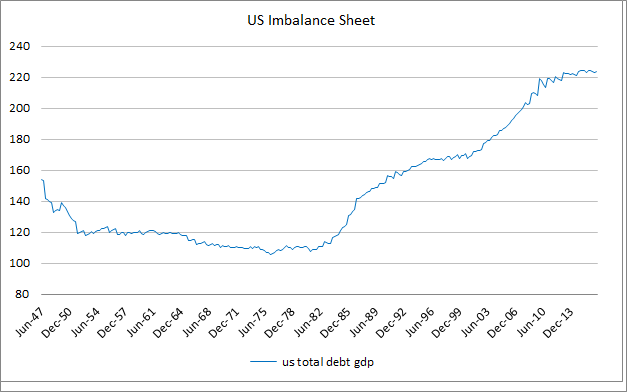
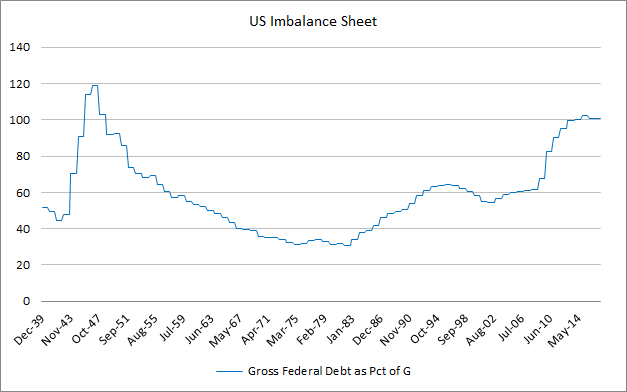
The current public debt levels in the US have risen from 60% of GDP to over 100% since 2008. World War II saw public debt levels rise from 45% to 120%. The latest crisis control has cost the US government half of the cost of WWII.

US Federal Debt as % of GDP:

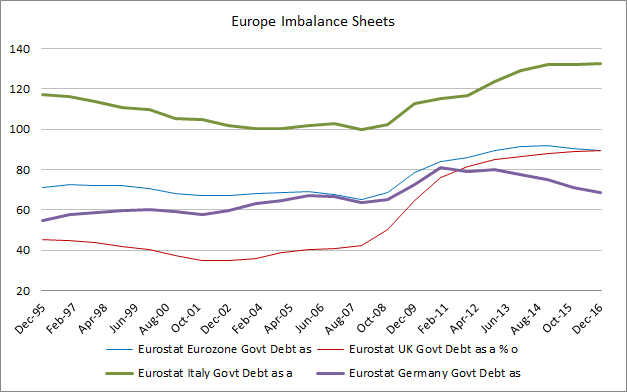
2008 bailouts cost European governments as well. Some countries managed to rein in their balance sheets but others have just kept going (Italy and the UK). Don’t bring up Japan. They are leading by miles with national debt at 2.5X GDP.

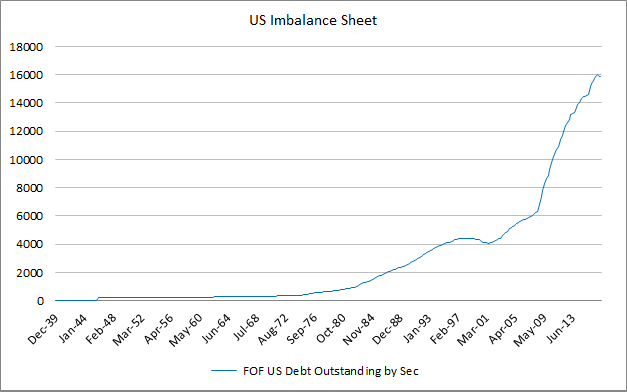
What does a government do in a financial crisis? Bail out the financial system, which includes the banks and their expensive managers and executives, since a failure of the financial system would inflict serious damage on the real economy, on output, employment and wages. Some compare this to Wall Street using Main Street as a human shield. And how does a government fund it?

Like this:

US Federal Debt Outstanding:

Thank goodness cost of debt was manageable. Imagine if the bond vigilantes had sold off US treasuries. But how does a government hold down the cost of borrowing?

Like this:

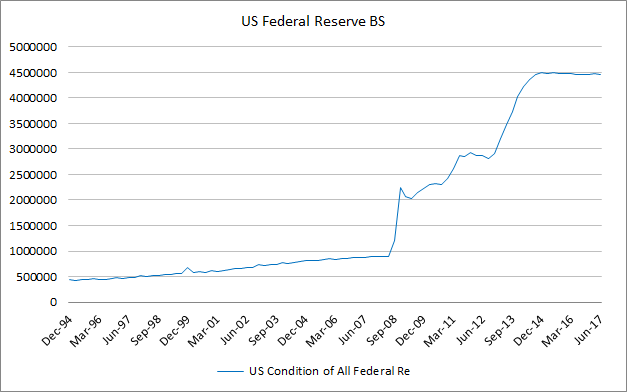
US Fed Balance Sheet:

If you face a buyers’ strike, there is nothing like buying your own bonds yourself. If you give it a scientific sounding name like quantitative easing (QE) and support it with academic research and the endorsement of renowned academics, it likely to appear less fraudulent.

9 years after the crisis and the economy has picked up and the justification for accommodative policy is receding. The Fed has begun (in 2015) to raise rates gradually and is considering normalizing its balance sheet. To what extent and how quickly can it normalize its balance sheet? It increased its balance sheet from just under a trillion USD to 4.4 trillion USD in the last 9 years. There will be limits to how much and how quickly it can reduce its balance sheet.

Here is one reason:

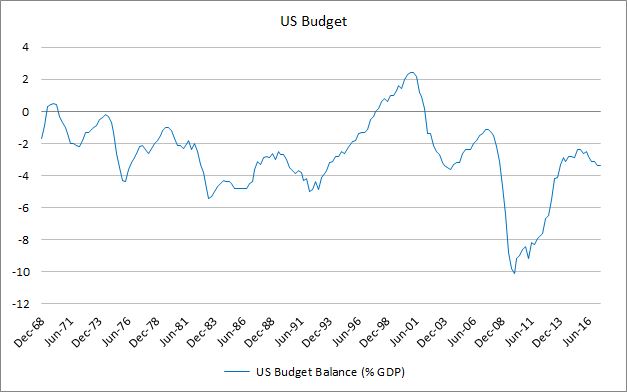
US Budget Balance as % of GDP:

If the current President’s plans to cut taxes and spend on infrastructure and defence are successful, the deficit will deepen, and it will need to be financed with more debt issuance.

The US needs to inflate away its national debt. However, rising inflation could threaten its long term funding costs which would force the Fed to remain underwriter for US treasuries. Ideally, the US would like to see asset inflation so that its asset to liability ratio improves in real terms, but low CPI inflation so that funding costs don’t rise excessively. This has been precisely what the economy has experienced these past 9 years. It is either a fortuitous coincidence or exceptional management by the Fed and Treasury.

Best guess predictions:

The Fed will raise rates gradually. They will also pay attention to market credit spreads which determine the actual cost of funding for the real economy.

The Fed will want buoyant asset markets as this debases the national debt. The Fed will therefore be sensitive to equity market and credit market stability, not just real economy data.

The Fed will go quite slowly in reducing its balance sheet. It cannot afford for interest rates to rise too far as it will impact the debt service costs of the government. Bond yields are likely to be range bound. The trading range and cycle will be influenced by central bank guidance and high frequency data.

There is significant risk from inflation. If inflation picks up it could impact the ability of the government to refinance itself.

Long term fundamental problems which will have to wait:

There does not appear to be any intention to decrease the national debt. This places the government under constant financial pressure which means it cannot invest in infrastructure or undertake reform which may have short term costs.

The size of the national debt puts pressure on the Fed and Treasury to keep rates low which in turn encourages the private sector to borrow and increases the level of leverage in the economy. If rates are artificially suppressed both government and private debt levels will not have a reason to recede.

With a persistently high and increasing or non-receding level of debt, both the private sector and the government has every motivation to keep rates contained or low. Low rates provide the government and the private sector every motivation to borrow more.

The above feedback loop implies that interest rates will be kept low until such time it is impossible to keep them low. But what could precipitate such an eventuality?

Possibly, inflation accelerates, in which case the Fed will have to be extra vigilant, a stance which could invert the yield curve, a position associated with recessions. A recession could throw asset inflation in reverse thus increasing the relative size of the total debt. Any loss of confidence could also throw asset markets in reverse with similar effect.

A loss of confidence could introduce a risk premium into US treasuries, currently a remote concept, but such is the modern economy that most assets and markets derive a significant portion of their value from confidence.

Not about to be paid down soon:

  • all chart data sourced from Bloomberg


Make Britain Great Again.

It is very hard to optimistic about anything about Britain. The people are divided, quite evenly, between those who wanted to stay in the EU and those who would leave it. A referendum has effectively documented this fact. The decision was taken without a thorough understanding of the consequences of leaving the EU, as various emotional arguments were pitched at the people. The winning side, the ones who voted Leave, fled leaving the job for separation to a marginal and now questionable Remainer. She, Theresa May, promptly adopted a combative stance for separation, affectionately called Hard Brexit. Labour is led by a Far Left extremist occasionally hiding behind a suit and tie but mostly eschewing conventional politics and economics to the extent that he is reviled by his own party. So low was Jeremy Corbyn’s popularity that the Prime Minister decided to hold an early election to extend her slim Parliamentary majority. This she promptly lost by being vague, aloof, belligerent and unprepared, leaving the country with a hung parliament and a billion pound bill to the DUP for a confidence and supply agreement to prop up the Tories, though it is not clear what anyone is confident of supplying except an unconscionable alliance of convenience. Would a proper coalition have cost two billion pounds?

Unemployment has been mercifully low but so has wage growth, slowing most recently to outright decline (of 1.5% YOY). Inflation, so persistently low before has perked up to 2.9%, overshooting the Bank of England’s target. An acutely weak sterling is pushing up the price of imports and diminishing purchasing power. For multinationals and exporters, the weak currency has provided a boost. Sterling assets have also become cheaper to foreign buyers. However, separation from the EU and the common market will present some tricky problems.

If greatness is born in adversity then the current conditions in the UK are certainly hopeful. Some quarters of the UK government had talked of making London a Singapore-Upon-Thames, a problematic idea, though one that certainly highlights the merits of adversity. Singapore’s success was in part fuelled by the existential threat it faced when it was ejected from Malaysia in 1965. The world was simpler then and Singapore was surrounded by resource rich and complacent neighbours, as well as being simply too weak and puny to be a threat in the region. The UK is not so puny or weak, the neighbours are doing well, neither resource rich nor complacent, but a fairly united bloc of determined and well organized economies, in roughly the same level of development as the UK. Competition will be fierce and the prospect of pursuing an independent economic course unnoticed will be difficult.

To succeed, the UK will need unity and pragmatism. It already has know-how and enterprise but it will require unity so that some minority interests will be subordinated to the greater good and pragmatism to prioritize not only objectives but principles. It is not the most natural thing for a liberal democracy but since liberal democratic principles and favour are eroding, why waste a bad thing.

Corporate taxes should be cut. This will be unpopular with many but if they want jobs and growth, corporate domicile is what the country is offering and prices need to be cut. Companies and businesses are welcome, especially super-efficient ones.

Income taxes should be raised. The existing rates for the existing bands should be maintained or even cut but new higher bands should be created with higher marginal rates. The bands and rates should rise sharply.

Defined benefit pensions and healthcare to be partially substituted for a defined contribution scheme. This is to ensure solvency and accountability. Defined benefit social welfare is by nature profligate, insolvent, and opaque. Defined contribution social welfare places the responsibility on the individual, is by definition solvent, and is transparent. Where it fails is as a safety net if individuals have insufficient earnings to contribute in the first place. Hence the need for a combination of defined benefit and contribution schemes.

The creation of a Strategic Sovereign Fund or SSF. The SSF will invest the liquidity and reserves of the sovereign and social welfare schemes along both commercial and strategic lines. To insulate the social welfare scheme from the SSF, the scheme will purchase bonds guaranteed by the sovereign and the sovereign will capitalize the SSF with equity capital. The SSF will pursue an investment strategy to include making a decent return while managing risk appropriately, co-investing in foreign direct investments and investing in strategic industries and countries globally.

London’s firepower as a repository of financial intellectual property must be mobilized, packaged, managed and deployed. Financial technologies once reserved for elite or insular groups such as leveraged finance and structured credit should be packaged and offered as solutions. The SSF will co-invest and make markets where necessary and appropriate to bring sophisticated solutions to a wider world, and help to overcome such hurdles as initial liquidity and scale.

To make Britain great again there will be a load a’ compromisin’, but satisfying everyone will be impossible and clinging to lofty principles and academic ideals while the country suffers as a whole will be a luxury eschewed.